

AI Is Changing Work — But Maybe Not How You Think
Summary:
Anthropic — the company behind Claude — just released a detailed research study on AI’s real-world impact on the labor market. And the headline finding might surprise you: so far, AI has not caused a measurable spike in unemployment.
That doesn’t mean nothing is changing. It means the change is more nuanced, more targeted, and in some ways more interesting than the doomsday headlines suggest. Here’s what the research actually says — and what it means for your business.
A Better Way to Measure AI’s Impact
Most studies measure AI’s potential impact by asking: theoretically, which jobs could AI do? That’s a bit like measuring the impact of cars by counting how many people could theoretically be replaced by self-driving vehicles. It overstates reality.
Anthropic took a different approach. Instead of measuring what AI could do, they measured what it is actually doing — by analyzing real usage patterns from their Claude platform and cross-referencing them with U.S. occupational data. They called this “observed exposure,” and it paints a much more grounded picture.
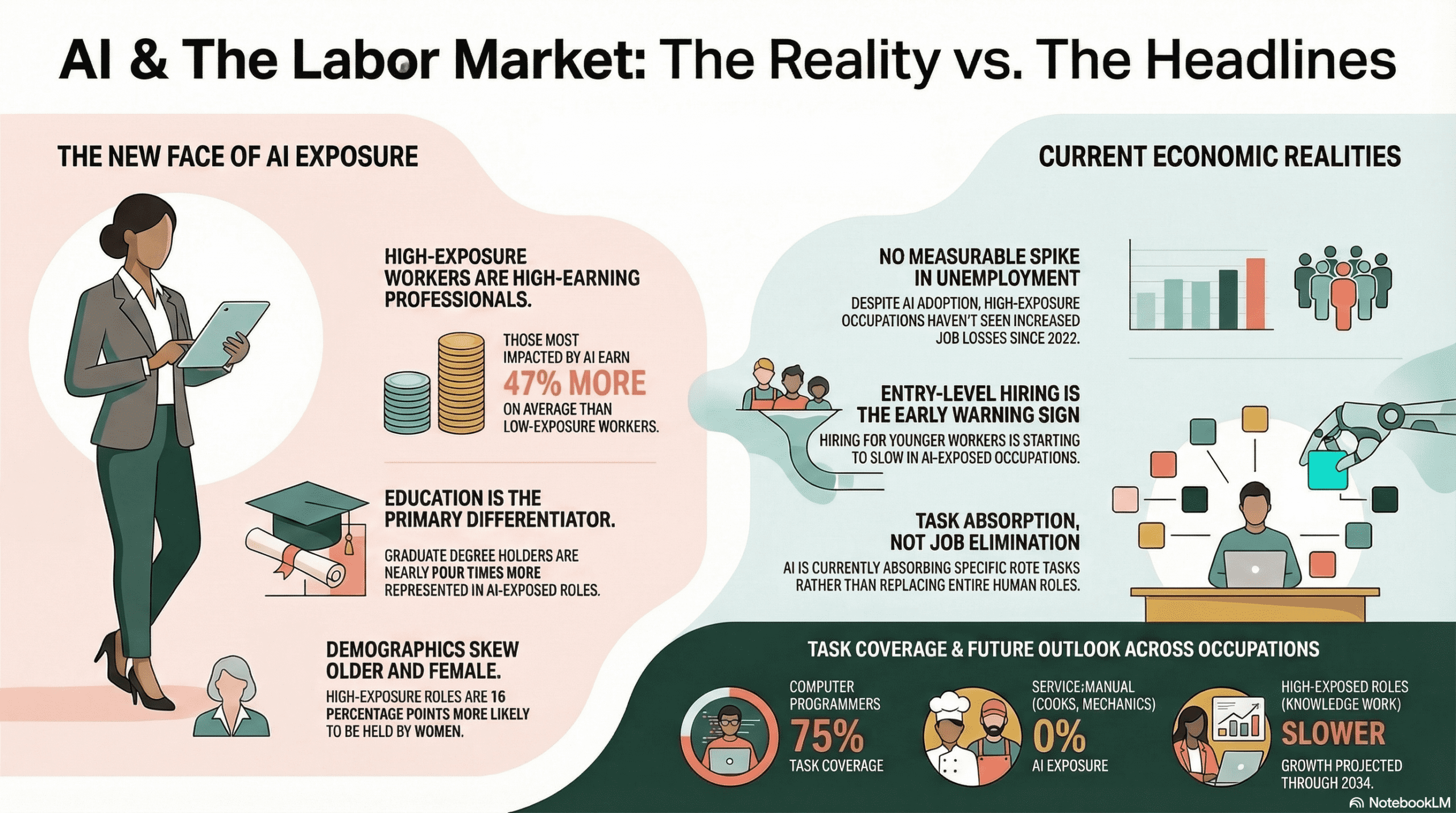
The result? AI is being used for a meaningful share of tasks in certain jobs, but even the most-exposed professions are far from fully automated. Computer programmers sit at the top of the list at 75% task coverage — meaning roughly three-quarters of their typical tasks appear in real Claude usage. Customer service reps and data entry workers aren’t far behind. Meanwhile, 30% of workers have zero AI exposure at all — think cooks, mechanics, bartenders, and lifeguards.
Who’s Actually in the Crosshairs
Here’s where it gets interesting: the workers most exposed to AI disruption aren’t the ones most people picture. According to the research, high-exposure occupations skew:
- Female (16 percentage points more likely than low-exposure workers)
- More educated (graduate degree holders are nearly 4x more represented)
- Higher paid (earning about 47% more on average)
- Older (not entry-level workers as commonly assumed)
This challenges the narrative that AI primarily threatens low-skill, low-wage jobs. White-collar, knowledge-based roles — the kind that often require a degree and pay well — are seeing more AI integration than manual or trade-based work.
What the Data Says About Jobs Right Now
No measurable increase in unemployment for high-exposure workers since late 2022. That’s the bottom line.
But there is one early warning sign worth paying attention to: hiring of younger workers appears to be slowing in AI-exposed occupations. Entry-level positions are quietly contracting. This isn’t a crisis yet — but it’s a pattern worth watching, especially if you’re thinking about workforce planning or hiring strategy.
The Bureau of Labor Statistics also projects that occupations with higher AI exposure will grow more slowly through 2034. Not collapse — just grow more slowly. Again, nuance matters here.
What This Means for Your Business
If you run a small or mid-sized company, here’s the practical takeaway from this research:
AI adoption is uneven — and that’s an opportunity. Most businesses haven’t come close to reaching AI’s actual potential, even in areas where it’s technically feasible. The gap between what AI can do and what businesses are actually doing with it is enormous. That gap is where smart operators are building competitive advantage right now.
Your highest-value roles are the ones to watch. If your team includes knowledge workers — analysts, writers, customer service managers, administrators — those are the roles where AI integration is already happening, whether you’ve planned for it or not. Better to build a thoughtful framework now than react to it later.
This isn’t about eliminating jobs. It’s about changing them. The research doesn’t show AI replacing workers at scale. It shows AI absorbing specific tasks within jobs. The businesses that will struggle are the ones that pretend this isn’t happening. The ones that will thrive are the ones building systems where AI handles the rote and humans drive the judgment.
The Bottom Line
Anthropic set out to track AI’s labor market impact before the effects become unmistakable — so that when disruption does emerge, we have the data to understand it clearly. That kind of methodical, evidence-based approach is exactly what we believe the business world needs more of right now.
The sky isn’t falling. But the ground is shifting. The organizations paying attention — and building AI-ready processes, people, and governance structures — will be far better positioned when the pace of change accelerates.
You can read Anthropic’s full research paper here: Labor Market Impacts of AI: A New Measure and Early Evidence.
About WHIM Innovation
WHIM Innovation helps organizations harness the practical power of AI, automation, and custom software to work smarter and scale faster. We combine deep technical expertise with real-world business insight to build tools that simplify operations, enhance decision-making, and unlock new capacity across teams. From AI strategy and workflow design to custom monday.com apps and fully integrated solutions, we partner closely with clients to create systems that are efficient, intuitive, and built for long-term success.